The Load-Bearing Artifact: Glitch and Architecture
Atoms and Pixels: The Building Blocks
The city, which can be thought of as a living body or even a motherboard, is still an undeniable symbol of progress and modernity. Perhaps it is why it's usually first to be decimated in any depiction of the Apocalypse. Nothing says the world is ending quite like collapsed bridges and destroyed apartment buildings.
Against the backdrop of broken architecture, overgrowth, and decay, we weave tales of failed systems, and the ruins that remain. There are zombies, lone survivors, and packs of wild dogs fighting for scraps under broken neon signs. Some buildings echo with howling wind, and others sizzle with static-like silence.
The spaces within these structures - rearranged by some force, be it nature or by design, violently or over long swaths of time - stubbornly endure like mausoleums. Missing walls. Stairs that go to nowhere. Floors covered in rubble. Impassable hallways and cracked concrete. Twisted steel wire with expired kinetic energy. There is danger hiding around every corner.
That is the image of the city, deconstructed.
Now imagine it as a digital simulation.
For the sake of artistic exploration we could assume that atoms and pixels are one and the same here.
And perhaps they are. There has been some discussion in the scientific communities whether the idea that we are currently living in a simulation, has any merit. Are our sensory experiences, and the trajectories of our lives managed by some divine algorithm?
Digital entities are subject to failure, either from inherent errors or outside disruption. The glitches that appear do two things. They reveal the nature of the system and what makes it tick, and they conceal how it works behind a new kind of aesthetic experience - the delight of seeing something unexpected, sometimes even more beautiful than the original entity.
The glitch frames the city as a chaotic wasteland of unruly (but freed) pixels. Serving as a lens, it lets us observe the true nature of our world: one that is not stable and certain, but one that is vulnerable, shaky, and ready to fall apart when pushed to extremes. The form changes before our eyes, like in the film Inception, where dynamic fractal-like architecture provided a stunning backdrop to the action packed dreams the characters had to navigate to extract the hidden truth.
And there is truth to discover here too. Beneath the shiny glass of the skyscrapers, there are cracks - openings through which we can travel down to where the machinery lies. The machinery built by humans who were full of mistakes. A machinery prone to malfunction.
The Bending and Breaking of Structures
The cityscape represents the system within which we go about our daily lives. It organizes our time into neat segments. It serves prompts at every turn. It is there "when you go to work... when you go to church... when you pay your taxes" (The Matrix).
But sometimes we feel that something is off. We notice the small failures, when the social code by which we abide does not work as intended, or the infrastructure we rely on fails and disrupts the flow of resources. As the city chugs along through time, some of the failures can amount to a catastrophe.
Then, the facade crumbles.
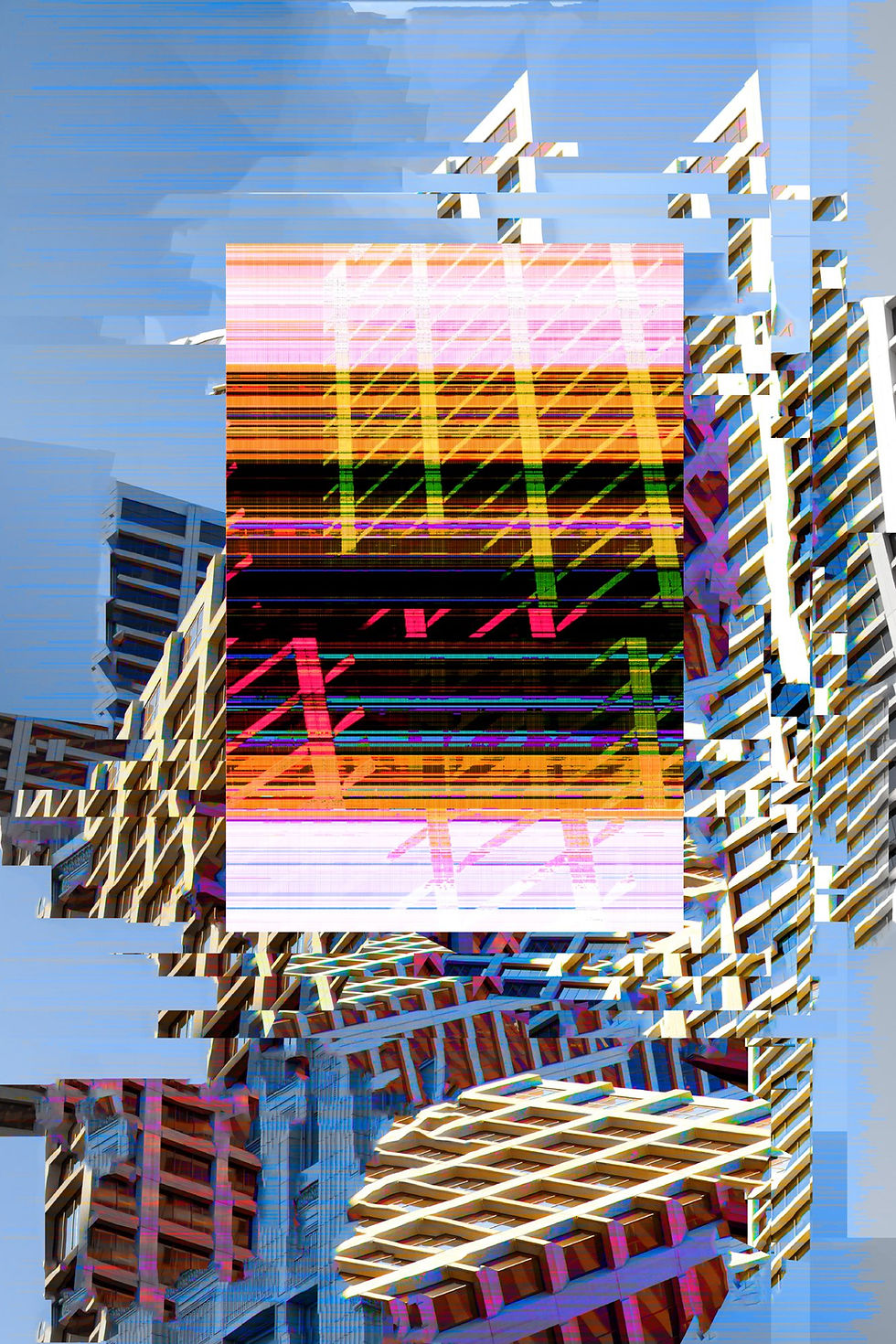
This impromptu architectural curation imagines an instance where the glitches amount to a catastrophic failure, throwing the photo-real depiction of the architecture into a visual spectacle. The broken data of the image parallels the brokenness of the city within its pixels. Now the glitch becomes the structural support, or "the spine" of the ruins that remain. The error dictates how the image, or the system, appears or functions.
It's not so much an act of vandalism against the digital powers that govern us - it's about reckoning with the system and re-evaluating what it teaches us.
Perhaps what the cityscape symbolizes is different for each of us, but in the end the city is a concentrated cluster of human productivity, creativity, resourcefulness, and cooperation. It is also a place of increased conflict, unrest, and competition. The city is a catalyst for all the positive and negative traits of human nature.
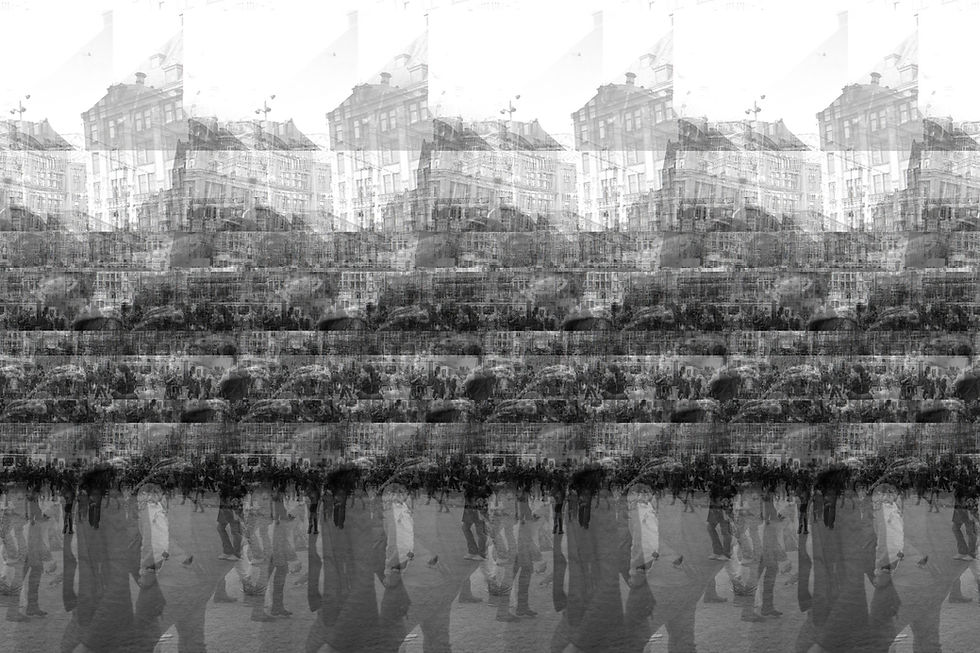
Perhaps the glitch decay is all about the process which dismantles the structure into the basic building blocks, leaving space for something new to be constructed in its place.
This is not about moralizing whether systems are bad or good. Systems serve a purpose, they provide structure. It is the intent of individual systems that should be scrutinized based on what they wish to achieve. Some are created with injustice already in the rough draft. Others strive to eradicate inequality.
The integrity of a system can be threatened from the the side of the hardware (the failure in the physical world like a climate crisis), leading to software not performing correctly; or from an error inside the code (financial system fraud), leading to real consequences for flesh-and blood people who rely on its workings.
So, what happens when a system collapses? And what is pulled into the void that remains? We cannot pretend that anarchy is a solution. Though its aim might be peace, the unscrutinized freedom that is living without rules and responsibility inevitably invites danger, mistrust, and a tribal kind of mindset that leads to isolation, and the sharpening or entrenching of competing viewpoints.
Humans thrive when they cooperate in groups of hundreds and thousands, naturally enabled by language - a vehicle for storytelling, sharing abstract ideas, describing value, and spirituality - a system which traces its origins to around 70 thousand years ago (Yuval Noah Harari).
Where other animals compete for resources, humans can cooperate and shape their lives because of the systems we have at our disposal.

But language, like any other system, is a living thing - it evolves - and as it develops over centuries, it is also subject to failure. It also invites constant scrutiny, or deconstruction.
Code is a type of language we use to command and communicate with machines.
When glitch artists say they want to lift the veil on the workings of technology, they are not promising to reverse engineer the code that makes an image file. At least for many of us, the purpose of exploration is to abandon that goal from the get-go. For me personally, I have to relinquish that need to understand, instead giving into the drive to explore. The goal ultimately becomes about "what do I do with how it looks when I break it?"
“Any sufficiently advanced technology is indistinguishable from magic.” - Arthur C. Clarke
The artist then has two choices: either to surrender to the magic of technology, or break the spell that ensnares the senses. But maybe the in-between state is a way forward. We want to live in the middle, where the two realms combine by osmosis, where technology and biology thrive interconnected.
To break the spell is to deny its power over the senses, To reveal the lie, is to indirectly point to the truth. The best way to bend the spoon is to realize there is none: "Then you'll see that it is not the spoon that bends, it is only yourself." (Matrix)
As virtual machines learn how to see (Midjourney, Firefly, Leonardo, etc.), we begin to learn how to un-see. We peel back at the layers of our perception, detaching it from the "seeing is believing" mode. Because today, seeing may not have any reference to reality at all.
However, as we unlearn how to see through the old system's lens, the new systems adopt our old biases.

Where does this leave our idea of the broken urban landscape?
To fully live we must surrender to the magic, knowing well that the spell may break without a warning.
These glitch pieces are an invitation to imagine ourselves walking through the ruins of our lives, keeping in mind that, the pixels can become atoms at any point in time.
Life is a mess.
Let's pick up the pieces.


Comments