The Art of Memory
Updated: Jun 1

"I don't remember." - this is my response to a lot of questions these days. Remembering is not what it used to be for me, I fail at it more often than I'd like.
Memory is a powerful tool in shaping our lived experience. Whether suppressed by choice in response to traumatic events, or continuously re-lived in our minds as a way to hold onto precious things - it is a nuanced visual spell that informs our current choices.
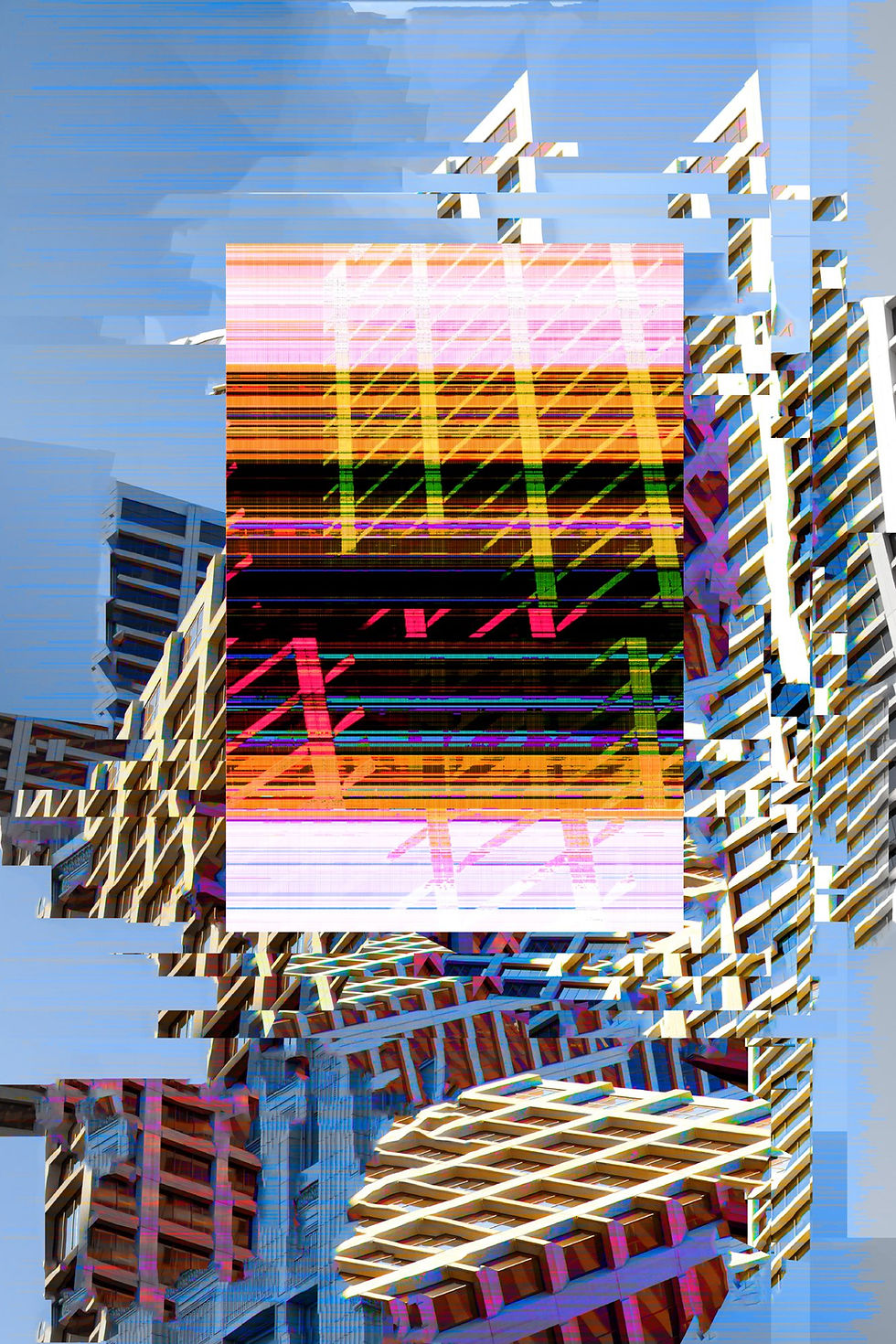
In my art, I have often used my own personal photography as source material for new pieces. Low resolution grainy photos or high-res scanned film have been my go-to way before the arrival of AI image generators. I have recently rediscovered some old hard drives holding treasures of familiar faces or places I've been to, and I couldn't help but engage with those memories again - and by engage I mean, scramble their pixels a little. For art.

The work presented here has been created in the last several years, as well as the 2011/2012 period when i began experimenting with glitch for the first time.
In my experiments I've tried to focus less on the appearance and familiarity of the subject matter, and more on the emotions that were triggered in the process of remembering.
I used glitch artifacts to comment on the passage of time, and how it degrades the accuracy of memories, but also how it tints or distorts the emotions associated with them..
As most of our memories are stored electronically in our devices in the form of pictures and videos, we think of them as permanent records that will last eons into the future, forgetting the fact that the cloud is very much resting firmly on the ground in the form of data centres full of hardware that is susceptible to degradation, and has to be maintained regularly in order to function - a good analogy to our own bodies. How often have we lost our precious pictures to a failed hard-drive, or a phone wiped by mistake? How many moments have we lost to time, our neural pathways withering away and barely buzzing with nostalgia?

Our brains are just as faulty as the machines we trust to preserve our life stories. And yes, they also glitch.
I read somewhere that every time we try to recall a memory, it is changed. A different tone, something added, or missing, perhaps a different point of view, or maybe a different perception on what took place, how, and when.
So how do we trust ourselves to know anything. Are we OK with approximations of our past experiences? Pictures and videos exist, but they never tell the whole story. They are simple impressions, or snapshots rather than detailed descriptions. They are reference points on a map that has already faded.
The truth is: we can never go back.
No time machine exists, and the vehicle of memory that we have, does not take us to the same place twice.
How can we frame a memory in a way that still feels familiar, even if it's never the same?
First of all, we must become comfortable with ambiguity. Then we can begin to trust our intuition.

Memories are imperfect fragments of our lives, that constantly rearrange depending on the mood. They float around as fleeting impressions: Mom and Dad's garden, an old self-portrait mid depressive episode, a walk down Amsterdam's Red Light District, a blooming cherry tree in Central Park, etc. But memories are just the beginning in this artistic process. They are the source, not necessarily the destination.
Sometimes the art becomes a self-contained memory with no reference to the actual point in time. It has transformed beyond a record of the event, and even moved beyond encapsulating the emotion.

It has grown a body of its own, with only a faint echo of its origins still embedded in the form. A gesture, a color, an outline, remaining like a sign pointing in a general direction, but never to a specific location.
It's like playing a game of Telephone as a child, each iteration of the repeated word is slightly altered, not by choice, but by error. What comes out at the end of the chain of innocent ears is a completely new sentence.
All information is vulnerable to corruption, but that corrupted information can be given a new life, or become a new life.
Periodic errors or glitches in our DNA, are essential to the process of evolution. Change is the only thing we can be sure is always coming. In our personal lives, in the workplace, in world affairs, in the biosphere, in the universe at large.
To resist change is a futile attempt to preserve something that can never be preserved. Whether a change is good or bad, depends somewhat on how we handle its consequences.
Perhaps creating art out of personal memories is an attempt to salvage decaying information by changing it on purpose - but according to a different process.

That new process, an intuitive extraction of threads that matter, elements that resonate, visual cues that always feel aligned with the original event, even if they no longer resemble it - removes the pressure of trying to remain faithful to the life you think you had.
After all, memories are fickle, and your or my account of events may vary slightly. It does not mean what I've experiences did not happen, or was not important. It does not mean our minds conjured up stories that never took place. But the varying perspective offers a multitude of entry points to examine the past. And each one may look different.
In the end we are not what happened to us, but how we got through it. We are no more than an approximation of a multitude of factors, and memories are only part of the bigger picture.

We may no longer remember the events that shaped our behavior, but we are still responsible for how that behavior affects those around us. Remembering helps us reconcile with the past, forgetting helps us move on, though it can also make us sick. Repressed traumatic memories can lead to physical illness.
Perhaps creating art out of visual memories is a way to process things in a constructive way.
It is freeing to think that what I thought was set in stone, can be obliterated by time, or a digital tool. It provides a degree of agency to a person who thought they had no control.
I hope you find some inspiration in these works to remember differently yourself.
Thank you for reading.

Comments